
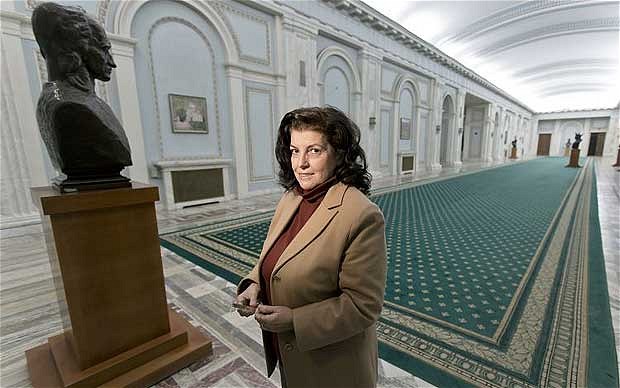
Oh, my! The Telegraph has an obituary of Romanian Architect Anca Petrescu that might as well conclude “Burn in Hell, you brazen hussy”:
Anca Petrescu, who has died following a road accident aged 64, was an architect known as the “Albert Speer of Communism”, responsible for the Romanian dictator Nicolai Ceausescu’s “Palace of the People” in Bucharest — the world’s greatest monument to totalitarian kitsch.
…
In February 1982, at the age of 32, Anca Petrescu was appointed chief architect of a project whose raison d’être, in Ceausescu’s tautological phrase, was to be “a grandiose edifice that reflects the epoch of the time”.
…
When interviewed about her role in building the People’s Palace, Anca Petrescu tended to lapse into evasive, Soviet-style doublespeak, cutting off interviewers brusquely if they enquired about her relationship with Ceausescu. When asked by one western journalist how she justified the suffering Romanians went through as a result of her work, she retorted: “That is a question originating from someone who can only understand a system based on profit as motivation.” Her favourite novels, she revealed, were the “sick works of Dostoevsky and Tolstoy, because they fit my soul”.
The story brings back a bit of the horror of Ceausescu. I recall my then-Calvinist heart swelling with pride as I read about how he was toppled by a doughty band of Romanian Calvinists, who probably toppled him from calloused knees.
I forget the details (but the New York Times remembers) and you’ve probably never heard them since the story’s pretty implausible in retrospect when everyone knows Ronald Reagan toppled Communism on his feet.
Oh. Margaret Thatcher, too. And ordinary Polish Catholics. Led by Lech Walesa. Sound track by the late Lou Reed. With a cameo appearance by Plastic People of the Universe.
But oddly, apart from episodes like the capture of Hussein or the death of Bin Laden, I don’t hear anyone claiming the success someone or other pulled off in Iraq and Afghanistan.
* * * * *
“The remarks made in this essay do not represent scholarly research. They are intended as topical stimulations for conversation among intelligent and informed people.” (Gerhart Niemeyer)
 Tipsy Teetotaler ن