
The mind boggles
Recently, I heard a gifted pastor, a man who leads a large nondenominational church, say this:
“You may not want to hear your pastor say this, but some of the things Jesus says are not very helpful. Loving your enemies, for example. We don’t need to love our enemies. We need to love our friends and crush our enemies.”
I winced, but I could hear my younger self trying to shock an audience with a line like that. I figured the pastor would follow up with something like, “But if that is what our Lord says, we need to be figuring out how we are going to obey him.”
No. His following comments dug in deeper. He said in essence that the Lord’s teaching was unrealistic and damaging to the present cause.
It astounded me.
How can one claim to be defending Christianity by disagreeing with what Christ said?
Defending Christianity? (I believe that this must have been my source for this old digital clip though I’m no longer on Facebook to confirm that.)
Doug Wilson
Calvinist provocateur has been getting a lot of press lately and he doesn’t even have a new book out:
Doug Wilson is not a prophet. He is a gifted writer, a trenchant cultural analyst, and a deliberate provocateur. As one observer memorably put it, “Doug is a Christian shock jock, a cable news host, a Daily Wire program (and I like a lot of what Ben Shapiro says).” Wilson’s approach reflects a right-wing attractional model characteristic of partisan punditry and movements, where the foil of political opponents seldom fades from view. The result is a message that tickles ears, entrenches self-righteousness, and bolsters partisan pride rather than cultivating prophetic witness.
If Wilson positioned himself simply as a cultural commentator, the problems would persist, and whatever good he offers could be found elsewhere without the accompanying liabilities, but at least the genre would be clear. The difficulty is that he holds the office of pastor in a church and denomination unwilling to discipline him for his excesses, however outrageous they become, leaving his rhetorical showmanship to be mistaken for faithful ministry. Worse still, he claims biblical warrant for language that Scripture itself calls ungodly.
…
Prophets Lament, Wilson Lampoons
Jeremy Sexton. If you don’t know who Doug Wilson is, congratulations! I, unfortunately, did know and once thought highly of him. Today, I’m not so sure that his contribution to Christianity is a net plus.
Old Scratch knows the Good Book
Jesus, in Luke 4, was tempted by the devil after 40 days of fasting.
What I had never noticed before is the escalation of the temptations. The first two temptations are pretty crass and Jesus answers them with “it is written.” So on the third temptation, Old Scratch goes all spiritual on Jesus and supports the temptation with his own “it is written” — indeed, with two “it is writtens.”
(And then my mind raced off to contemn snake-handling Pentecostals.)
Politics taints everything
It might have been expected that, since the situation in which the Greek hierarchy found itself after the fall of Constantinople seemed to provide it with an almost providential opportunity for the reassertion of the original and essential nature of the Church, it would have vindicated through its own actions its claims to superiority over what it regarded as the perverse confusion of temporal and spiritual in the Roman Church; but in fact the Greek hierarchy was to become involved in the ‘concerns of state’, the ‘things of Caesar’, to a degree which threatened not merely to confuse the spiritual and temporal, but to eclipse the spiritual altogether. For Mahomet II, in granting privileges to the Greek episcopate in the person of the Oecumenical Patriarch Gennadios, the first such Patriarch after the fall of Constantinople, did so in accordance with the Islamic tradition that a ‘nation’ (millet) is determined by its religious status: he looked upon the Greek Christians as a ‘nation’ of which the Patriarch was the ‘national’, temporal head, and not, as he is according to Orthodox tradition, merely the bishop of one particular local sacramental centre. Hence it was that the Patriarch assumed what the Pope already possessed, something of the power that belongs to Caesar.
Philip Sherrard, The Greek East and the Latin West
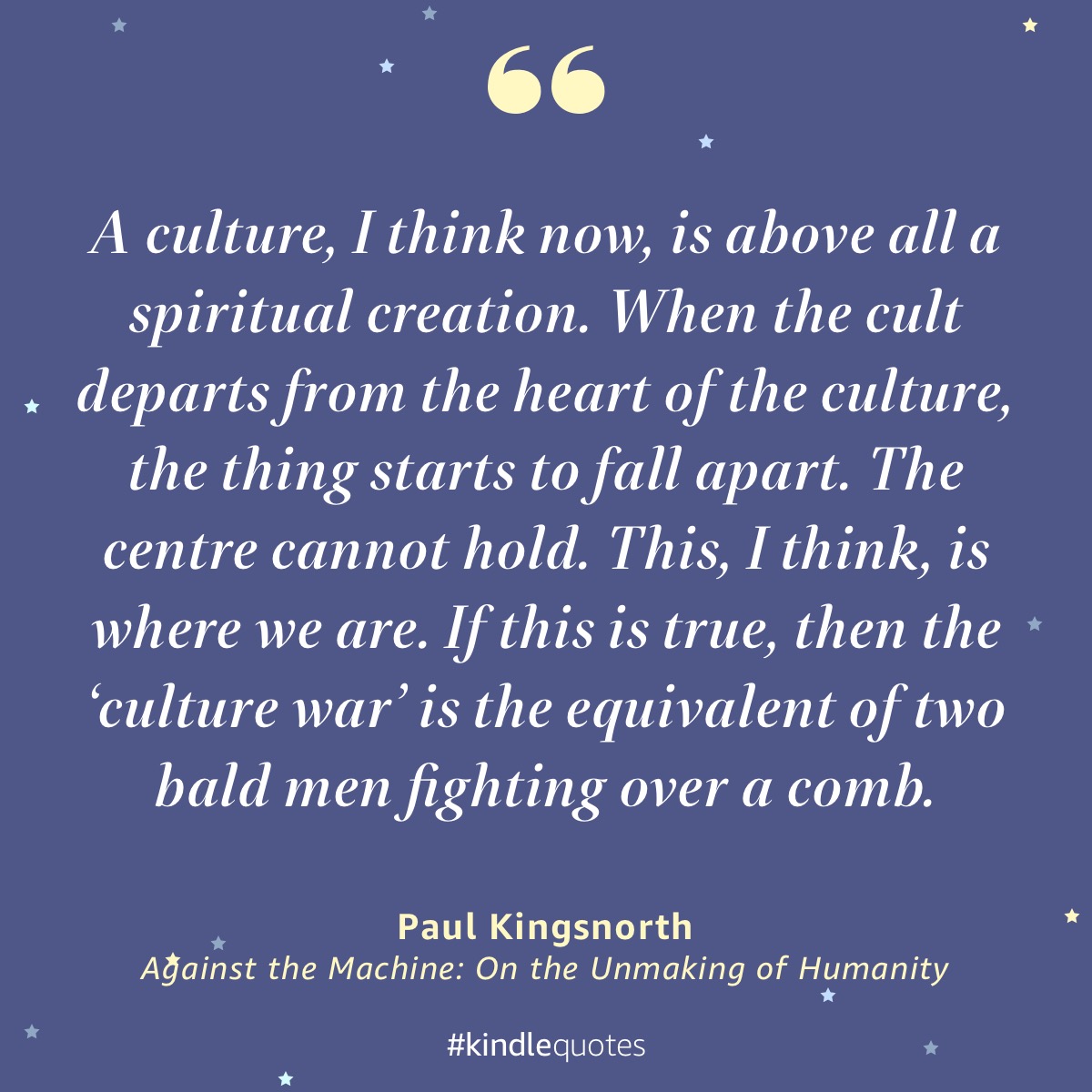
Culture wars
Destitute
Most medieval Europeans probably understood better than do nearly all Westerners today that acquisitive affluence is not a prerequisite for human flourishing—even though they also knew, in times of famine, for example, that utter material destitution made flourishing nearly impossible.
Brad S. Gregory, The Unintended Reformation.
Is this the religious right today, or should I look elsewhere?
A week ago there was a marathon funeral or memorial service for Charlie Kirk. I didn’t know about it in advance, and after it was over I only saw (1) Erika Kirk’s speech and (2) maybe a few other snippets. My first impression was of a syncretistic mash-up of Christianity and Americanism.
My delayed impression, though, was of an orderly affair, without (many if any) calls for vengeance. If this is the “religious right” of 2025, I don’t think secularists or religious folks ouside it have much to fear.
Damon Linker largely agrees, though he wrote a critique of the religious right in 2006 titled The Theocons. He concedes he may have been too shrill in 2006, but also sees more reassuring “facts on the ground” in 2025. He still fears the Right, but no longer so much fears the “religious right.” What gives?
On February 29, 2016, just as the pundit class was beginning to realize that Trump just might manage to win the Republican nomination that year, New York Times columnist Ross Douthat tweeted the following: “A thought sent back in time to the theocracy panic of 2005: If you dislike the religious right, wait till you meet the post-religious right.”
That’s a quote from Linker, and one he uses a lot. There are the Stewart Rhodeses and Andrew Tates and too many others to name who are a both non-Christian and a greater threat than TPUSA.
But “If this is the “religious right” of 2025 …” isn’t a throw-away line. I’m not entirely convinced that it is. But it is, as they say (or used to say), a “datapoint.”
I’m not sure I’ve digested this yet
It is time to recognize the Non-Denom Church as its own cultural and institutional force. It is likely to endure into the future as its own branch of Christianity, with much of its Protestantism left behind.
LONG FORM: Does Traditional Protestantism Have a Future?
Religious ideas have the fate of melodies, which, once set afloat in the world, are taken up by all sorts of instruments, some woefully coarse, feeble, or out of tune, until people are in danger of crying out that the melody itself is detestable.
George Elliot, Janet’s Repentance, via Alan Jacobs
[N]one of the things that I care about most have ever proven susceptible to systematic exposition.
Alan Jacobs, Breaking Bread With the Dead
You can read most of my more impromptu stuff here and here (both of them cathartic venting, especially political) and here (the only social medium I frequent, because people there are quirky, pleasant and real). All should work in your RSS aggregator, like Feedly or Reeder, should you want to make a habit of it.
 Tipsy Teetotaler ن