On an Australian podcast episode, exploring an emerging narrative that the American Orthodoxy is full of toxic, hypermasculine “Orthobros,” Khouria Frederica Matthewes-Green expressed appreciation for how Orthodox Christianity doesn’t change. Another participant, Fr. Doru Costache, challenged that by noting, correctly, that the Liturgy we do now isn’t exactly what the Orthodox Church used to do.
It’s possible that people raised in the Orthodox Church, “cradle Orthodox” (I’ll adopt Fr. Doru’s term), don’t see the Church’s essential changelessness like outsiders do, because they’ve never experienced the raucous, rending change that drove converts to their doors. I could only think, you have no idea what I mean by “change.”
Change is when your bishop says that the Theotokos was not a virgin, and the evangelist Matthew “invented the Virgin Birth to respond to criticism that Jesus was a bastard.”
Change is when your bishop says it wouldn’t matter if an archeologist found Jesus’ remains, because the Resurrection was not “a conjuring trick with bones.”
Change is when a Protestant pastor asks his bishop what he thinks of a famous bishop’s assertion that Jesus did not rise from the dead, and he replies, “I haven’t made up my mind about that yet.”
(This pastor told me, “I went home and started packing.” He ended up as an Orthodox priest.)
Change is when a national gathering of bishops doesn’t have enough votes to pass this resolution: “Clergy should abstain from sex outside of marriage.”
Change is when a diocesan convention doesn’t have enough votes to pass this resolution: “Jesus is the Way, the Truth, and the Life; no one comes to the Father except by him” (John 14:6).
Or, to go from tragedy to absurdity:
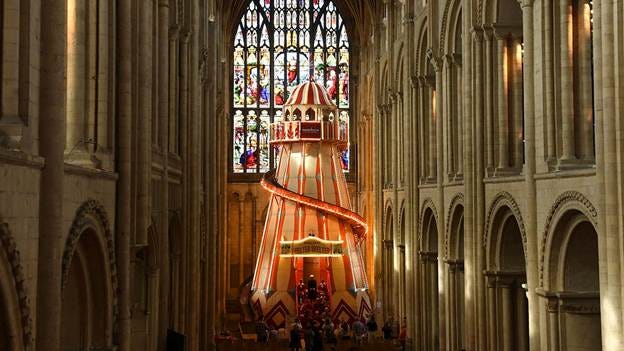
Change is when your bishop builds a giant “helter skelter” carnival ride inside the cathedral.
Isn’t there something really creepy about this? Creepy in a Tolkien sense. [Fox News 2019-8-8; photo PA News Agency, dist. by Associated Press]
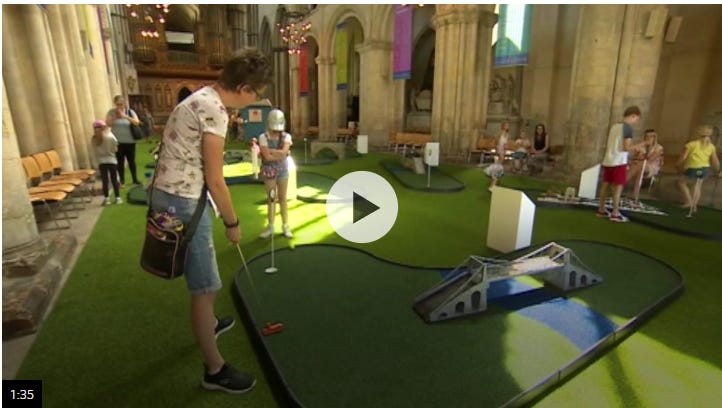
Change is when your bishop builds a mini-golf course inside the cathedral.
One clever journalist called it a “Fairway to Heaven.” [BBC.com, 2019-7-30]
Oh yes indeed, I know what change looks like. But the evolution of the Liturgy in the early centuries? That’s not what I mean by “change.”
The Changeless Core. When I say Orthodoxy is changeless, I mean that there is an inner core that persists across all nations and jurisdictions, across all centuries. It is a practical thing, a way to get closer to Christ. And that’s what I love about Orthodoxy, that it has brought me closer to him. (Fr. Doru asked “Why so much effervescence?” That’s why.) The Apostles must have known this deep-rooted longing, and it stretches from them to the present, through everyone who loves him, through all the ages.
Krouria Frederica’s blog post, Cradles, Converts, and Orthobros, is unusually long, and convincingly takes on some falsities in current media narratives about Orthodoxy.
I appreciate the narratives, perversely, as milestone of sorts. I entered the Church realizing how different it was, and that it was at least a tacit rebuke to modern Western Christianity (and culture). But almost nobody was attacking or critiquing it; we were too few, too “ethnic,” to be taken seriously. For an example, my Christian Reformed pastor, with whom I spoke about my interest in Orthodoxy, could only critique it as if it were Roman Catholicism.
So as I entered Orthodoxy, I braced myself for the day (for I had a gut feeling Orthodoxy was going to grow in America) when we were big enough to be attacked and critiqued more often.
So no, you can’t prove by me that there are any Orthobros in the Church (as opposed to internet noise or guys who show up with some twisted thinking but lose it in catechesis), but I appreciate that you’re taking us seriously enough now to concoct lurid narratives.
An aside: I notice on re-reading them, that the quotes above about real “change” all involve bishops. Khouria Frederica and her husband came to Orthodoxy from the Episcopal Church, ECUSA, which has long had notorious bishops (Bishop Pike being the first one I remember). So, much as I contrast Orthodoxy with Evangelicalism, she contrasts it, mostly, with Episcopalianism and progressive outposts in Roman Catholicism.
But don’t think that “lower” churches are exempt from baneful changes. Khouria Frederica, beginning with a section under the rubric “More masculine,” compared to what? writes about changes and distortions that, in my impression, mostly occur in Churches that try to avoid “liturgy” and denominational ties.
Back to the main subject, with a little stage-setting. I’m a Cantor in my parish. I have duties in my Parish that keep me from being a roving sociologist of Orthodoxy in America generally. I probably haven’t been in more than a dozen other parishes over my nearly thirty years in Orthodoxy, and I’ve only been in a handful of liturgies overseas during travels (and most of them were in monastic settings).
That my mental stage when I got to Khouria Frederica’s final thoughts, which opened new mental vistas for me (and made me suspect that my parish “vibe” is pretty typical of American Orthodoxy):
I tried to express this to Fr. Doru, but went overtime, and some of it was cut from the ending of the show. But here’s a summary of what I wanted to say, with some further thoughts that came to me, as I drove on into the night:
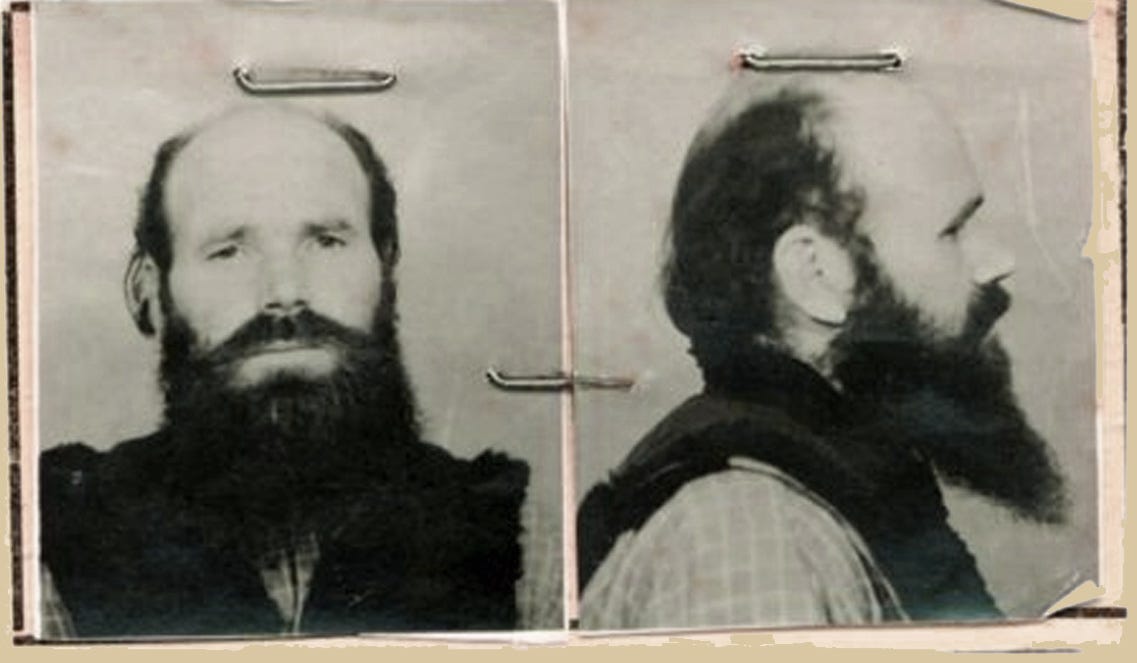
Penitence. I love Romanian Orthodoxy. I was blessed to have Fr. George Calciu, a survivor of Soviet torture, for my spiritual father. And I loved Fr Roman Braga, another survivor of the prisons. It was something Fr. Roman said that I’m thinking about now.
Fr. Roman Braga at his third arrest, 1958
Fr. Roman always said that every ethnic group has to work out its own kind of Orthodoxy. Americans will have to make an American Orthodoxy, and it won’t look like Romanian or Greek or any other kind. We will create our own American kind of Orthodoxy.
But I suspect that this American kind will be offensive, to some … We’re too loud, too bold, too informal. We smile too much … it’s just what Americans are like. We laugh, we’re loud, we’re expansive.
An example of the difference is that cradle Orthodox don’t want to have noisy children or babies in the church. People raised in Orthodoxy have a profound sense of awe about the temple, and treat the building itself with great respect. So they say, “Don’t bring a baby in the church! This is a holy temple, not a nursery!”
But Americans like having babies in church. They say, “If you can’t hear crying, the church is dying!” A church with wandering toddlers, and little boys gazing at a candle flame, and schoolgirls cuddling newborns—all that seems exactly right.
I know how beautiful Orthodoxy is, so I need to ask your forgiveness, because what Americans are going to do with it might look cheap to you. It might look like marketing. It might even look disrespectful. It won’t look like Romanian Orthodoxy. It will be the Orthodoxy that grows out of our distinctive American life. Forgive me, forgive us, for what we are nevertheless going to do, as we create this thing never seen before, American Orthodoxy.
It’s not just babies we welcome. It’s visitors, too. Come and see.
Apophatic
Orthodoxy theology defines only what is necessary and always leaves unspoken that which cannot be explained. This approach was part of the Christian faith from the beginning. But the Western phronema often suppresses, dismisses, minimizes, or ignores this stance. The Western mind is compelled to define and explain everything, since without a rational explanation a concept or fact cannot be considered true, or, conversely, all truth can be proven rationally.
Dr. Eugenia Scarvelis Constantinou, Thinking Orthodox.
I experienced this apophatic approach to theology, gradually over decades losing my tendency toward being the kind of person who today cataphatically thinks, oh, for instance, that he could create a computer administered questionnaire that would logically force people to confess the correct version of Christianity.*
Only then did I encounter neuroscientist and philosopher Iain McGilchrist. Getting to know McGilchrist confirms for me the deep wisdom of the Orthodox way, and I believe McGilchrist has been quoted as saying that if he became a Christian (in the narrow sense, not “culturally Christian”), he would be Orthodox.
In my mind, this is closely related to what I consider the Orthodox view of the Nicene Creed and the Ecumenical Councils more generally.
Ecumenical Councils are not summoned because Bishops need some way to spend their lavish expense accounts (as if!). They are called because of the perception that some rascally teacher or teaching is threatening the Church. A Council convenes, considers the matter, and declares the mind of the Church. At the Councils of Nicea and Constantinople, two of the earliest Councils, they considered the teachings of rascally Arius, condemned them, and set forth the Church’s mind in the form of the Nicene-Constantinopolitan Creed, typically shortened to “Nicene Creed.”
In Orthodoxy, we call the Creed “the Symbol of Faith,” which itself signals our view: the Creed is not, and was never intended to be, a precis of all mandatory parts of the faith.
As a consequence of this limited role of Councils, I view the Creed and the Canons to be markers of boundaries to keep the faithful safe — as if to say “this is a cliff; stay away!” or “here be dragons.” That leaves a whole lot of geography in which believers can and do move around fairly freely.
As in paradise, so many delights are allowed, so few forbidden — and even that for our good.
(* Actual delusion, but I was a Calvinist at the time.)
The cultural formations of western Christianity
Christianity as we see it in eighteenth-century Britain or twenty-first-century America is not Christianity as it has always been, and the more fundamental changes may not be those that the received history of religion narrates. The cultural formations of western Christianity, growing as they do in good part from binary, Protestant-Catholic debates, can be thrown into stark relief, for instance, when studied in comparison to that much neglected third term in Christendom: the Eastern Orthodox churches from which Rome severed itself nearly half a millennium before the Reformation, charting a course for Western Christianity wed to rationalism and enamored of individual authority, whether papal or personal.
Lori Branch, Conclusion: on the Religiousness of Criticism in her book Rituals of Spontaneity.
I just noticed, with much delight, Branch’s gimlet-eyed phrase “the Eastern Orthodox churches from which Rome severed itself” (italics added). This Great Schism is one of those fundamental changes that in received Church history in the West almost invariably inverts, by commentators Catholic, Protestant or unbelieving — who assume reflexively that four patriarchs in a pentarchy severed themselves from the fifth, which on the face of it is less plausible than the one severing from the four.
Something that sticks with me
Some decades ago, the late Richard John Neuhaus coined (so far as I know; I’d never heard it before) the term “ecclesial Christian.” He describe an ecclesial Christian as one for whom faith in Christ and faith in His Church is one act of faith, not two. (That may not be exact, but it’s how I’ve appropriated it for myself.)
I feel compelled to surface the term periodically to try popularizing it.
In the American fissiparous (there I go again!) nondenominational/megachurch/religiopreneur environment, the term is useful, and maybe even necessary, to demarcate the boundary between that sort chaos from a handful of Christian traditions in which the Church is central, not just more or less helpful to individual believers.
I was probably on the chaos side when I first encountered the term (I think it was the early ‘90s, the early days of First Things magazine) but it stuck with me, and I now, though firmly Orthodox, I feel a special kinship with ecclesial Christians outside my specific faith.
Christian America
Sociologists who look at American politics right now say that a major thing that’s driving our politics, maybe the major thing among white evangelicals, is that this is the group that has always assumed it should have the predominant role in American society. It’s the founding faith. It’s what the founders were.
No, the founders were not evangelicals, especially not in the contemporary devolved sense. That’s my story and I’m stickin’ to it. David Barton and his ilk have never persuaded me otherwise.
Far too good
The modern world is not evil; in some ways the modern world is far too good. It is full of wild and wasted virtues. When a religious scheme is shattered (as Christianity was shattered at the Reformation), it is not merely the vices that are let loose. The vices are, indeed, let loose, and they wander and do damage. But the virtues are let loose also; and the virtues wander more wildly, and the virtues do more terrible damage. The modern world is full of the old Christian virtues gone mad. The virtues have gone mad because they have been isolated from each other and are wandering alone. Thus some scientists care for truth; and their truth is pitiless. Thus some humanitarians only care for pity; and their pity (I am sorry to say) is often untruthful.
As a new convert, [St. Seraphim Rose] had some pretty strange views … Fr. Seraphim called it the “crazy convert” phase. But as he got older, more mature, he outgrew those views—as we hopefully do. And he helped his spiritual children to do the same. And that is what made him a saint.
He came to realize that what Orthodoxy had to offer isn’t a pure, unbroken tradition. It’s not a perfect adherence to the canons. It doesn’t make us better than everyone else. No! Fr. Seraphim said (and this is a quote):
The deepest and most attractive thing about Orthodoxy today is its message of love. The most discouraging thing about today’s world is that it has become so cold and heartless. In the Gospel of St. Matthew our Lord tells us that a leading characteristic of the last times will be that the love of many will grow cold. And the Apostle of love, St. John the Theologian, records our Lord as saying that the chief distinguishing mark of His disciples is the love they have one for another.
(…)
Being filled with the Gospel teaching and trying to live by it, we should have love and compassion for the miserable humanity of our days. Probably never have people been more unhappy than the people of our days, even with all the outward conveniences and gadgets our society provides us with. People are suffering and dying for the lack of God, and we can help give God to them. The love of many has truly grown cold in our days—but let us not be cold. As long as Christ sends us His grace and warms our hearts, we do not need to be cold.
Michael Warren Davis, on Monk-Priest Seraphim Rose, who reposed in 1982, and is now becoming officially recognized as an Orthodox Saint.