If you believe that all reactions ought to be ‘rational’, which means open to examination by calculative reason, then all reactions which stem from felt intuition, but which reason has trouble explaining, are at a disadvantage. This explains why a mystic will never win a debate with an atheist: he may have a truth on his side, but it will not be demonstrable through anything other than personal experience, and that doesn’t count. Therefore, he loses.
I understand why we developed a social convention that one is only obligated to believe things that can be rationally proven. But I do not understand the irrational corollaries that one is barely permitted to believe what one cannot rationally prove and certainly may not try to persuade others of it.
I don’t think those corollaries are straw men, but I have no rational proof at hand that they’re real.
One person seeks to be admired for the clothes he is wearing; another seeks the same admiration in priestly vestments. One wishes to be admired for singing on stage, another for chanting in church. One wants to be thought of as tough and cool, another as prayerful and humble. It is the same vainglory in them all.
Vassilios Papavassiliou, Thirty Steps to Heaven
More Anecdata
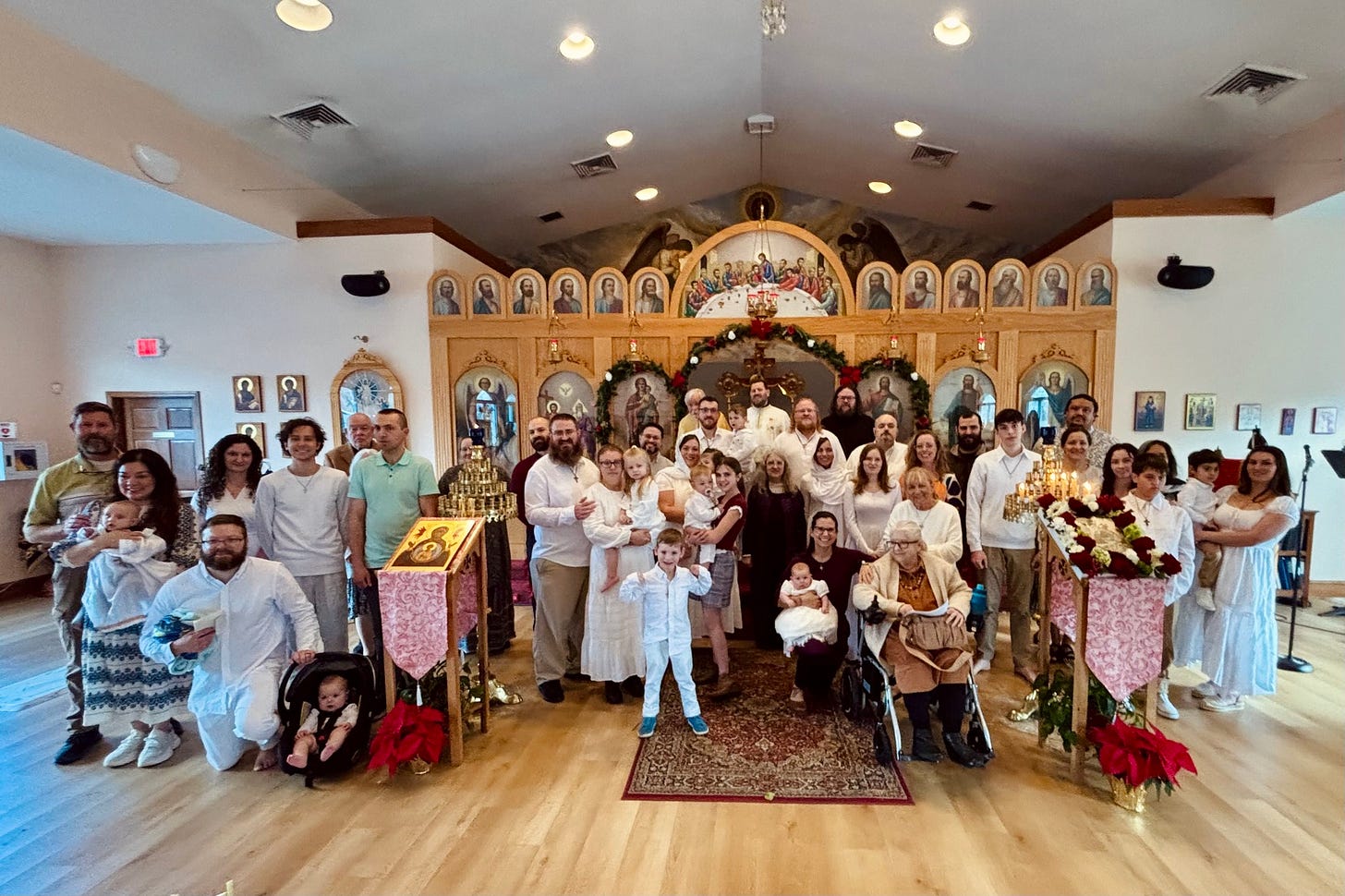
A congregation that is overflowing. On Christmas Eve morning we baptized 25 adults and 2 babies. We borrowed a second adult-size immersion “font” (actually, a Rubbermaid cattle trough) from a neighboring church, and the two priests just kept baptizing side-by-side till they got through them all.
Also, you can see that the majority of the baptized, wearing white, are young. This is going on all over the country. It’s a fine time to be Orthodox, just as a wave is rising. It’s not always been this way in the past, and may not always be this way in days to come; but right now, it’s pretty terrific.
Iona remained a place of pilgrimage, until the Protestant Reformation snuffed out its monastic life. The abbey was dissolved, and its traditions dispersed.
Nothing makes me angrier at the Protestant Reformation than two sentences like this, which recur depressingly in history.
Orthodox Christianity is the branch of the Christian faith that split from Roman Catholicism in the Great Schism of 1054.
Nothing makes me angrier at lazy journalists than a sentence like this, which recurs depressingly in stories about Orthodox Christianity.
The Orthodox side had four patriarchs. The Roman Catholic side had one patriarch, who had increasingly claimed supremacy over the four others. Prima facie, if you know nothing but that, who’s likelier to have been schismatic: the one or the four?
The Journalist even knows better, though he hasn’t bothered connecting the dots:
[Orthodox Christianity] retains the early creeds, sacraments, and saints of Western Christianity; but where the Western faith has diverged, its theology, liturgy, and rhythms of life have remained unchanged.
UPDATE: I left a thought hanging. The second sentence makes me angry because the Protestant Reformation sometimes bore an uncanny resemblance to ISIS, destroying anything “religious” it didn’t understand, including genuine and venerable Christian practices and symbols its bad religion disallowed. See Eamon Duffy, The Stripping of the Altars: Traditional Religion in England, 1400-1580.
Reaching the lost as a journeyman trade
Finney’s Lectures on Revivals of Religion (1835), which is discussed at greater length below in chapter 15, was important for summarizing a new approach toward reaching the lost. Since God had established reliable laws in the natural world and since humans were created with the ability to discern those laws, it was obvious that the spiritual world worked on the same basis. Thus, to activate the proper causes for revivals was to produce the proper effects: “The connection between the right use of means for a revival and a revival is as philosophically [i.e., scientifically] sure as between the right use of means to raise grain and a crop of wheat. I believe, in fact, it is more certain, and there are fewer instances of failure.”
Because the world spiritual was analogous to the world natural, observable cause and effect must work in religion as well as in physics. The wine of revival—confidence in God’s supernatural ability to convert the sinner—may have looked the same in antebellum America as it had in earlier centuries, but the wineskin was of recent manufacture.
This account of Finney’s stunningly presumptuous theory of revival is in a section of Noll’s book titled “Assumptions and Assertions of American Theology.” I strongly suspect that this theory is how we got the foregrounding of manipulative rhetorical technique:
The rising and falling of the preaching voice; the shouting followed by the whisper
dimmed lights
“every head bowed and every eye closed” altar calls,
If manipulating people to an emotional climax, to get insta-saved, is your metric for “revival,” I suppose Finney was right. But I’ve lived too long and seen to much to think that such manipulated response is in any very meaningful sense a conversion to Christian faith. The wiser course is the Orthodox catechumenate.
What St. John Chrysostom knew that Jefferson Davis wanted to forget
Chrysostom’s Homilies posed problems for slaveholders, as elsewhere in this work the bishop instructed Christians to educate their slaves and manumit them as soon as possible.
Paul Gutacker, The Old Faith in a New Nation. I had never heard of St. John Chrysostom until I entered an Orthodox Church for a Sunday observance of his Liturgy. He was perhaps the greatest preacher in Christian history — in the 4th century.
Credit where credit is due: though Gutacker is neither Orthodox nor Roman Catholic, he knows of Chrysostom.
Is Christianity a Religion?
I recall the formulation, uttered many times in my presence (or written many times in sources I read), that “Christianity is not a religion; it’s a relationship.”
As best as I can recall, I thought that was facile, though not entirely worthless, and was formulated in response to a then-current cultural bias that religion was bad (which bias I think I never shared).
But here’s a weightier explanation of why Christianity is not a religion:
Nowhere in the New Testament, in fact, is Christianity presented as a cult or as a religion. Religion is needed where there is a wall of separation between God and man. But Christ who is both God and man has broken down the wall between man and God. He has inaugurated a new life, not a new religion.
Unlike immediately after the Protestant Reformation, almost all Christians today are happy to affirm that Protestants or Catholics or the Orthodox are truly Christians—and are thereby burdened to explain why their differences actually matter. The partial success but overall failure of the modern ecumenical movement has meant that many members of churches, especially Protestant, have become fundamentally post-denominational in their outlook. When churches can acknowledge that other churches from whom they are separated are equally valid as Christian churches, but don’t overcome the actual divisions, the unintended message is that the divisions are evidently not so theologically important after all, and the result is a church culture of consumer choice about where to worship and what to believe. But a faith decision based on preference is no faith decision at all—it permits no authority. The agony of those with faith is to respond to authority in this situation of choice.
Matthew Burdette, Zero Gravity. I struggled with “the unintended message is that the divisions are evidently not so theologically important after all.” It seemed to me that the unintended message is that that divisions are important — almost like we’re just being polite when we acknowledge that other traditions are Christian, too. But he said “that the divisions are … not so … important,” not “that doctrine is not important.” We’re too dismissive of the grave sin of schism seems to be his meaning.
I’m going to forego my temptation to theorize why we’re dismissive of schism.
No, on second thought, I’m going to give the short answer: we’re “making a virtue of necessity.” We can’t stop doing it, and we’re good people, aren’t we? So how can it be all that bad?
Religious ideas have the fate of melodies, which, once set afloat in the world, are taken up by all sorts of instruments, some woefully coarse, feeble, or out of tune, until people are in danger of crying out that the melody itself is detestable.
George Elliot, Janet’s Repentance, via Alan Jacobs
[N]one of the things that I care about most have ever proven susceptible to systematic exposition.
You can read most of my more impromptu stuff here and here (both of them cathartic venting, especially political) and here (the only social medium I frequent, because people there are quirky, pleasant and real and it has no-algorithms). All should work in your RSS aggregator, like Feedly or Reeder, should you want to make a habit of it.

 Tipsy Teetotaler ن