(This is how Orthodoxy views this Sunday; it celebrates Orthodox iconodules triumphing over iconoclasts.)
“You are not Jesus”
[I]t’s good to remind ourselves periodically of the first rule of Scriptural exegesis: You are not Jesus. Whenever you read a story about Jesus’s life, you should not identify with Jesus. You should identify with the sinner whom He is healing/converting/forgiving/upbraiding/flagellating/etc.
…
Whenever a traditional Christian defends some point of traditional Christian morality, you’ll hear one of our lefty friends cry, “I thought Jesus ate with prostitutes and tax collectors!” Once again, the proper response is: Do you identify with Jesus in that parable?
This is where liberal Christianity becomes—ironically; hilariously—elitist. Sorry, folks, but God’s not saying you must condescend to eat with sinners. No: you are the sinner. He condescends to eat with you.
As for us recovering sinners (i.e., Christians) Saint Paul gives us a different rule: “But now I have written to you not to keep company with anyone named a brother, who is sexually immoral, or covetous, or an idolater, or a reviler, or a drunkard, or an extortioner—not even to eat with such a person” (1 Cor. 5:11). Why? Because, not being Jesus, you can’t trust yourself not to fall into their vice.
I don’t know how to discern when a Substack is public, but this one is so good, I’d urge you to at least try reading the whole thing.
Hangovers
It was not that we got drunk. No, it was this strange business of sitting in a room full of people and drinking without much speech, and letting yourself be deafened by the jazz that throbbed through the whole sea of bodies binding them all together in a kind of fluid medium. It was a strange, animal travesty of mysticism, sitting in those booming rooms, with the noise pouring through you, and the rhythm lumping and throbbing in the marrow of your bones. You couldn’t call any of that, per se, a mortal sin. We just sat there, that was all. If we got hangovers the next day, it was more because of the smoking and nervous exhaustion than anything else.
I had totally forgotten this passage, which both came as a shock and struck me as very perceptive.
Chesterton loves him some saints
St. Francis, in praising all good, could be a more shouting optimist than Walt Whitman. St. Jerome, in denouncing all evil, could paint the world blacker than Schopenhauer.
But then eventually they lowered their voices again.
The decline of denominations and the rise of crypto-baptists
[A] new rightist group has emerged to “reinvigorate” the Southern Baptist Convention, which it fears is sliding into wokery. Its executive director is a self-identified “Christian nationalist.” Count me skeptical that many Southern Baptists are succumbing to progressivism. I’m also skeptical that the Southern Baptist Convention, which has been declining for nearly 20 years, will exist as a strong denomination ten years from now. Its churches and seminaries likely will align with non-denominationalism, whose ethos is chiefly Baptist.
The decline if not collapse of denominations in America means Christians, even if they remain in denominations, no longer are influenced by centralized structures but are mainly influenced by their self-chosen social media. Decades ago progressives gained control of Mainline denominations whose members were still mostly traditional. In post-denominational America that strategy is no longer relevant. Unalloyed religious progressivism can be found at outlets like Sojourners, which long tried to stay friendly to orthodox Protestants and Catholics but now touts transgenderism and a phalanx of other progressive causes. Fifteen to twenty years ago, the National Association of Evangelicals, as I noted nearly a decade ago, shifted from conservative to more centrist. But groups like NAE, like the National Council of Churches, no longer count a great deal in post-denominational America.
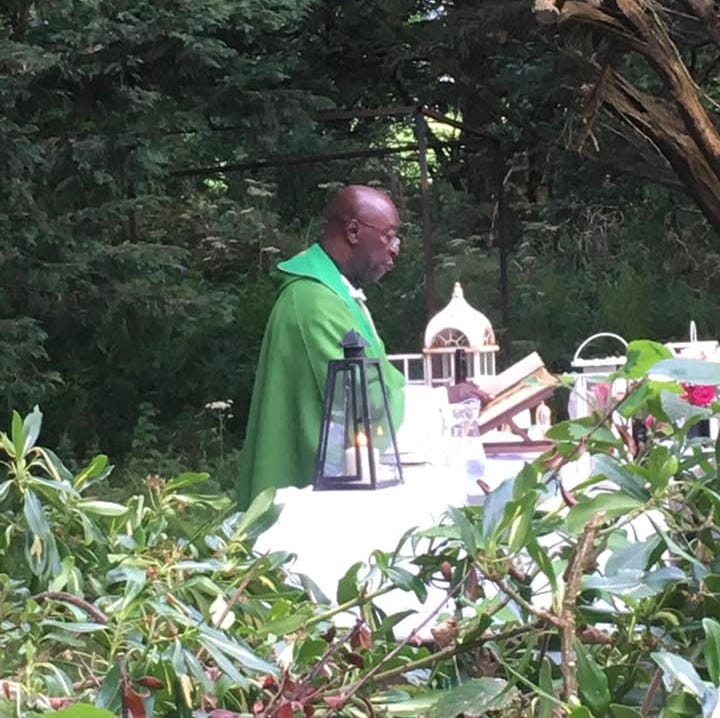
Cluain Patrick (the Irish word Cluain translates as ‘meadow’) is still a working community well, and one way you can tell is that a new altar has been built near it. This is not unusual at wells near towns, where an outdoor mass is often held on the saint’s day. Perhaps one will be happening here today. Here is the local priest at work three years back:
You may have noticed that this priest is not a native Irishman. This is increasingly common across the country. The land which used to produce one priest per family can now barely find a handful of Irish men who want the job. As a result, there has been an influx of priests from other nations, and those nations are usually outside Europe, in parts of the world where Christianity is still taken seriously. I don’t know where the priest in this picture is from, but in my local Catholic church the African pastor is from Nigeria – and yet he has the deliciously Irish name of Father Ciaran. I hadn’t realised until recently that Nigeria was originally evangelised by Irish Christians. Now it seems the favour is being returned. We are the pagans now, and we need all the help we can get.
I’ve expected for a few decades that the day would come when Christian Africa would be evangelizing the West. I didn’t expect I’d still be alive when that day arrived.
… that Christ may dwell in your hearts through faith; that you, being rooted and grounded in love, may be able to comprehend with all the saints what is the width and length and depth and height — to know the love of Christ which passes knowledge; that you may be filled with all the fullness of God.
You can read most of my more impromptu stuff here and here (both of them cathartic venting, especially political) and here (the only social medium I frequent, because people there are quirky, pleasant and real). All should work in your RSS aggregator, like Feedly or Reeder, should you want to make a habit of it.

 Tipsy Teetotaler ن