
Fretting about Orthodoxy in America
My priest went to a diocesan retreat this Spring and reported upon his return that our parish is relatively healthy. But our Bishop will be closing a lot of parishes this year because people haven’t returned after Covidtide and there’s a shortage of priests to boot.
This got me thinking again about a fact that I need better to reckon with: not all Orthodox parishes are both healthy and welcoming to American inquirers.
I’ve heaped much praise on Orthodox Christianity, but the truth is that I always had in mind some amalgam of my parish, a handful of other parishes I’ve visited, and the great Saints we venerate. I consistently block memories of perhaps half the parishes I’ve visited — parishes that, had they been the first Orthodox Churches I’d entered, might well have sent me away thinking “this isn’t for me.” I won’t name names (nor even ethnic adjectives).
But my bad impressions, too, are anecdotal, completely lacking in rigor. So I’m not going to say to inquirers “avoid parishes of [this or that] ethnic identity.” I’ll only give a rule of thumb to “find a parish that uses English for most of its liturgy.” I probably could find my way through the Divine Liturgy in just about any language, but that’s after 25+ years of being Orthodox.
I’m grateful for the lively, diverse and youthful parish I serve in my way as a tonsured Reader. I’m grateful because I’m human, and while I like decency and order in worship, those aren’t incompatible with a bit of enthusiasm, lusty congregational singing, beautiful icons and all that.
So maybe I need to focus on inviting local folks to my parish rather than inviting people on social media to visit an anglophone parish in their area.
But what advice can I give those social media “friends,” whose local parish may be pretty unattractive?
That question kind of stumps me. All I can think of is that we’re lucky to live in an age where we have many excellent resources available, both online and, even more, in print from major Orthodox publishers. That’s no substitute for Church, but since even good priest can have hobby-horses and skewed perceptions, it’s a good idea even for those in attractive parishes to supplement their church experience with reading.
Rough edges
I continue to be amused at the alarm sounded by our online Orthodox “Guardians of the Faith” regarding the growth of Orthodoxy in the South. Apparently, there are Southern conservatives becoming Orthodox. Lord, help us! I think my sons and I must have been the last semi-moderate converts to Orthodoxy down here–everyone since has been more conservative than us. Somehow, we worship together just fine. And, if these converts stick with it, Orthodoxy will hone off the rough edges; as it did for me. It is not the end of the world.
Terry Cowan (bold added).
Quest for Certainty
The Reformation is the first great expression of the search for certainty in modern times. As Schleiermacher put it, the Reformation and the Enlightenment have this in common, that ‘everything mysterious and marvellous is proscribed. Imagination is not to be filled with [what are now thought of as] airy images.’ In their search for the one truth, both movements attempted to do away with the visual image, the vehicle par excellence of the right hemisphere, particularly in its mythical and metaphoric function, in favour of the word, the stronghold of the left hemisphere, in pursuit of unambiguous certainty. … What is so compelling here is that the motive force behind the Reformation was the urge to regain authenticity, with which one can only be profoundly sympathetic. The path it soon took was that of the destruction of all means whereby the authentic could have been recaptured.
Iain McGilchrist, The Master and His Emissary
Undeniable propositions versus rites, ceremonies and sacred mysteries
These five Common Notions, described as “five undeniable Propositions” in De religione gentilium, are: 1. That there is one Supreme God. 2. That he ought to be worshipped. 3. That Vertue and Piety are the chief Parts of Divine Worship. 4. That we ought to be sorry for our Sins, and repent of them. 5. That Divine Goodness doth dispense Rewards and Punishments both in this Life, and after it … By shearing away all the practices of ancient people in his discussions of what was essential and original in these religions, Herbert contributed to the growing sense that religion was a matter of beliefs apart from “various Rites, Ceremonies, and Sacred Mysteries.” Religion was for Herbert a mental phenomenon. This view of religion as a set of beliefs that could be either true or false would become standard in the next century.
Brent Nongbri, Before Religion: A History of a Modern Concept (emphasis added)
Larping Christendom
Note, however, that reentry by travel and also exile (see below) nearly always takes place in a motion from a northern place to a southern place, generally a Mediterranean or Hispanic-American place, from a Protestant or post-Protestant place stripped by religion of sacrament and stripped by the self of all else, to a Catholic or Catholic-pagan place, a culture exotic but not too exotic (Bali wouldn’t work), vividly informed by rite, fiesta, ceremony, quaint custom, manners, and the like. This is by no means a Counter-Reformation victory because the attraction is not the Catholic faith— which is absolutely the last thing the autonomous self wants—but the decor and artifact of Catholic belief: the Pamplona festival, the Taxco cathedral, Mardi Gras, and such.
Walker Percy, Lost in the Cosmos (italics added).
(Yes, I’m aware that Lost in the Cosmos is a mock self-help book.)
Going to the gym
Worship is the arena in which God recalibrates our hearts, reforms our desires, and rehabituates our loves. Worship isn’t just something we do; it is where God does something to us. Worship is the heart of discipleship because it is the gymnasium in which God retrains our hearts.
James K.A. Smith, You Are What You Love
Chastening
For those who, like me, have led charmed lives, one of the really disturbing scriptures is “whom the Lord loveth, He chasteneth.“
Is my “chastening” to bear a few annoyances with less petulance? Really?
Platonic Christianity
That the soul was immortal; that it was incorporeal; that it was immaterial: all these were propositions that Augustine had derived not from scripture, but from Athens’ greatest philosopher. Plato’s influence on the Western Church had, in the long run, proven decisive.
Tom Holland, Dominion
No fundamental divide?
Although Europeans universally acknowledge the fundamental significance of the dividing line between Western Christendom, on the one hand, and Orthodoxy and Islam, on the other, the United States, its secretary of state said, would “not recognize any fundamental divide among the Catholic, Orthodox, and Islamic parts of Europe.”
Samuel P. Huntington, The Clash of Civilizations and the Remaking of World Order
Some poor, phoneless fool
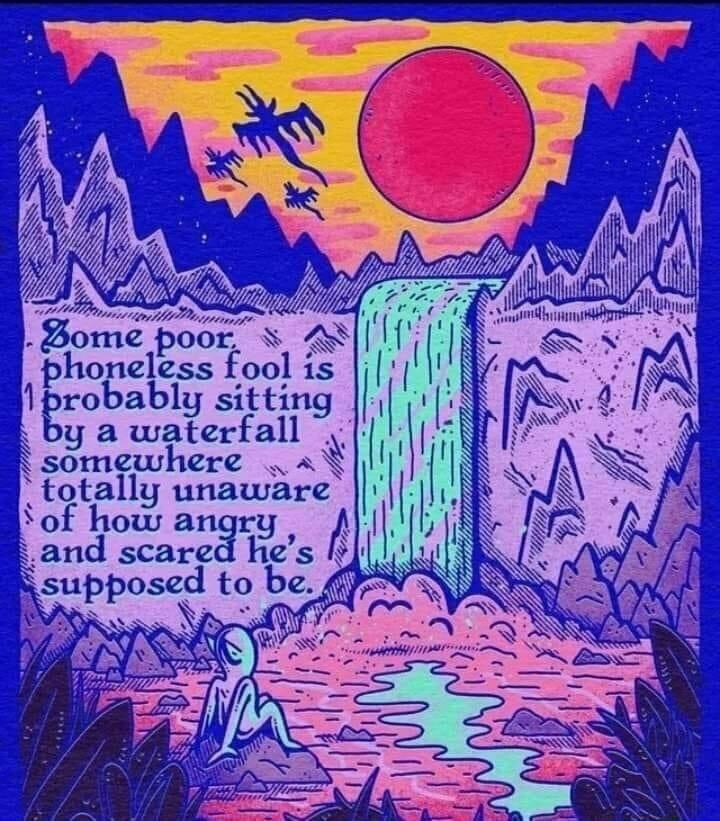
Via @letters on micro.blog
We are in the grip of a grim, despairing rebellion against reality that imagines itself to be the engine of moral progress.
The end of the world as we know it is not the end of the world.
You can read most of my more impromptu stuff here (cathartic venting) and here (the only social medium I frequent, because people there are quirky, pleasant and real). Both should work in your RSS aggregator, like Feedly or Reeder, should you want to make a habit of it. I’m even playing around a bit here, but uncertain whether I’ll persist.
 Tipsy Teetotaler ن