
Having previously sandboxed politics, I can give you something entirely different now (with the sole exception of the last Wordplay entry).
What to do with a whistle-blower
When someone blows a whistle, one option is to smear them for months and hire a billboard truck to keep it up. The other option is to take a breath and listen.
Nellie Bowles (hyperlink added)
I remember the days when GLAAD was against defamation. It was right in its name. But when you’ve got a nice grift going, you don’t let a little something like winning stop you; you reinvent your mission and carry on.
Our cult of expertise
“Doctor’s Orders.” In a brilliant cover story for Harper’s, Jason Blakely delves into the ways that COVID exposed the epistemic contradictions at the core of American public life: “American democracy and scientific authority are suffering parallel crises of credibility, each standing accused by the other. This twofold crisis has many causes, among them political polarization and the spread of misinformation on social media, as well as long-standing antirationalist religious traditions and anti-intellectual strains in American business and culture. None of these factors should be minimized when attempting to understand America’s widespread antiscientific sentiment. But they need to be supplemented by another, far less widely acknowledged, fount of skepticism—one that requires contending with what the populist view gets right: scientific expertise has encroached on domains in which its methods are unsuited to addressing, let alone resolving, the issue at hand.”
Re-read that last sentence.
I first noticed this, and objected strenuously, when MDs were asked to opine on the “quality of life” of unconscious patients — a philosophical question on which MDs had and have no expertise. If I’d been a judge, I’d have sustained an objection on that basis. Doctors would sometimes make up “suffering” through the supposed indignity of utter dependence on others, assuming that a rational person would prefer death (and that by starvation and dehydration, no less) over total dependence.
(Gilbert Meilander once wrote a column titled I Want To Burden My Loved Ones, bless him. That was pretty counter-cultural.)
Potemkin Forest
He stumbles back through the curtain of concealing trees, crosses the road and peers through the woods on the other side. More moonscape stretches down the mountainside. He starts up the truck and drives. The route looks like forest, mile after emerald mile. But Douggie sees through the illusion now. He’s driving through the thinnest artery of pretend life, a scrim hiding a bomb crater as big as a sovereign state. The forest is pure prop, a piece of clever artistry. The trees are like a few dozen movie extras hired to fill a tight shot and pretend to be New York.
He stops at a gas station to tank up. He asks the cashier, “Have they been clear-cutting, up the valley?”
The man takes Douggie’s silver dollars. “Shit, yeah.”
“And hiding it behind a little voter’s curtain?”
“They’re called beauty strips. Vista corridors.”
“But … isn’t that all national forest?”
The cashier just stares, like maybe there’s some trick to the question’s sheer stupidity.
“I thought national forest was protected land.”
The cashier blows a raspberry big as a pineapple. “You’re thinking national parks. National forest’s job is to get the cut out, cheap. To whoever’s buying.”
Richard Powers, The Overstory. The book is fiction, but I suspect this bit’s fact-based.
Troll Epistemology
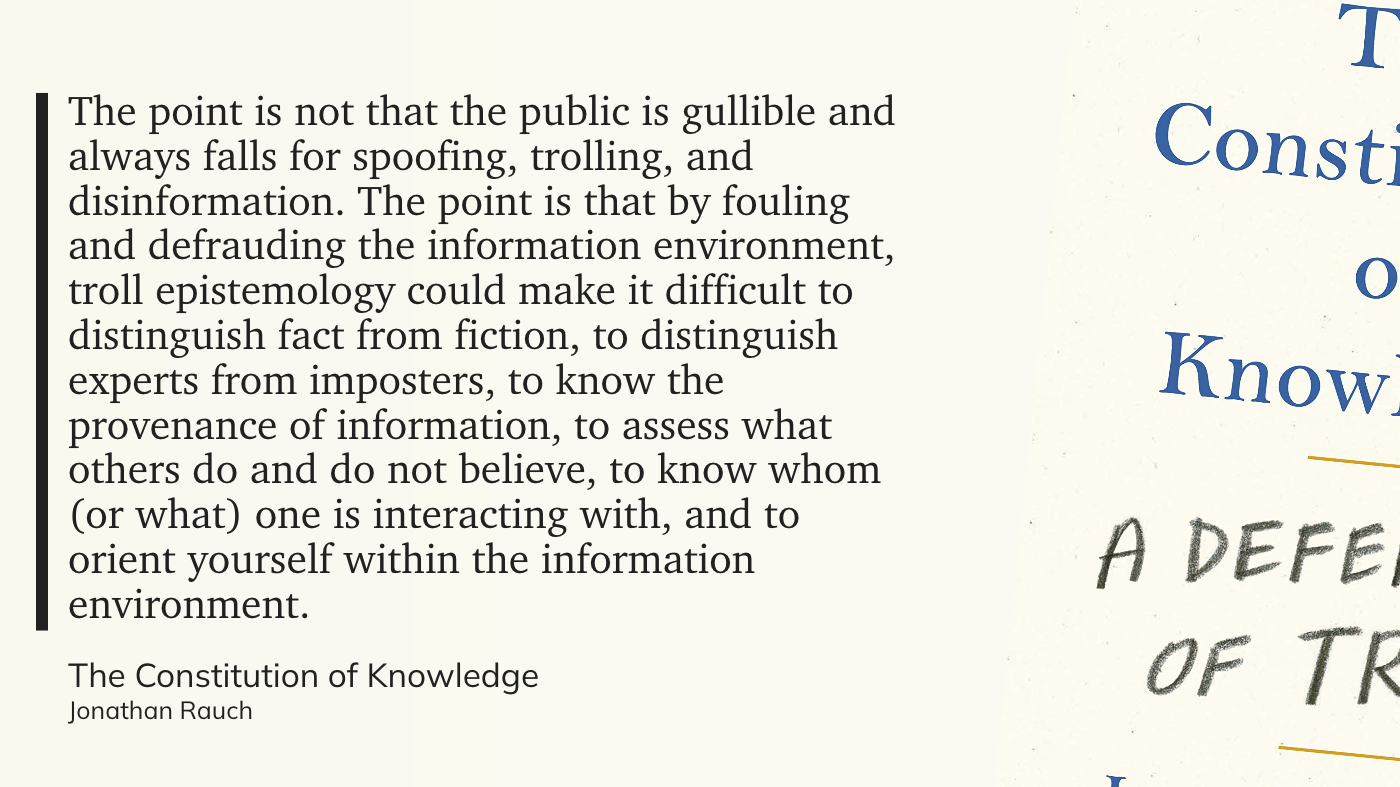
On a related note:
It’s called the “good cop, bad cop” routine, but in practice the bad cop always comes first. Softens you up, makes you want it to stop. Then comes the good cop with a kindly smile and a quiet voice. Or: You were right to think of social media as rage-bait, but you were mistaken about what came next, what happened after you took the bait. So much shouting, such cacophony; you needed to escape. You couldn’t stop scrolling, not altogether, not at first, but you needed something more soothing…on another screen. Theses days the big streaming services push showrunners to make TV shows less demanding of viewers’ attention—they say, This isn’t second screen enough, it needs to be smoother, like smooth jazz, like visual Muzak. Calming. …
Alan Jacobs, The Way Your Mind Ends. Do click through and read on; it’s short enough, and I thought it unfair to Hedgehog Review to copy and paste all of it.
Wordplay
Must everyone grind the same axe?
The “She didn’t write the article I wanted her to write!” critique trap.
I doubt that Jesse Singal coined that phrase, but I encounter what it describes all the time. Occasionally, the omitted point or theme might have made “the article” stronger; oftener, it’s mostly a demand that everyone grind the same axe.
Pronoia
Pronoia the belief that the universe is conspiring in your favour – the opposite of paranoia. (H/T Dense Discovery)
Beauty
Beauty is only skin deep, but ugly goes clean to the bone.
Dorothy Parker
Russian rallies
I went to a rally, and what happened? Did it change anything? Yes it did: I was fired!
A Russian participant in a Carnegie Endowment study on a rally against the Ukrainian invasion by Russia, via Plough.
Everything sounds better in French
Word of the week: portrait parlé, or “speaking image”, the original name for the modern mugshot, which was invented in France. Donald Trump had his taken on August 24th. Read the full story.
Truth
The truth is not facts. They come and go. They truth is a deeper, more anarchic weave of polyphonic eruptions.
Martin Shaw via Tad Hargrave, Into the Marvellous: The Art of Oral Storytelling + Travelogue + Interview With Martin Shaw From His Canadian Tour
Translation
We have to speak of something of which it is the whole point that people did not speak of it; we have not merely to translate from a strange tongue or speech, but from a strange silence.
G. K. Chesterton, The Everlasting Man
Sarah Palin
… the John the Baptist of lowbrow right-wing populism …
Nick Cattogio’s description of Sarah Palin.
Since joining the Dispatch, Nick (who I rarely read before) has quickly become a favorite.
 Tipsy Teetotaler ن